Groceries Are the Category Nobody Can Estimate
Ask someone what they spend on food at home and you'll hear a number. Check the actual total and it's higher — usually by a lot. The category moves every week, it hides household goods inside it, and the receipt goes in the bin before anyone reads it.
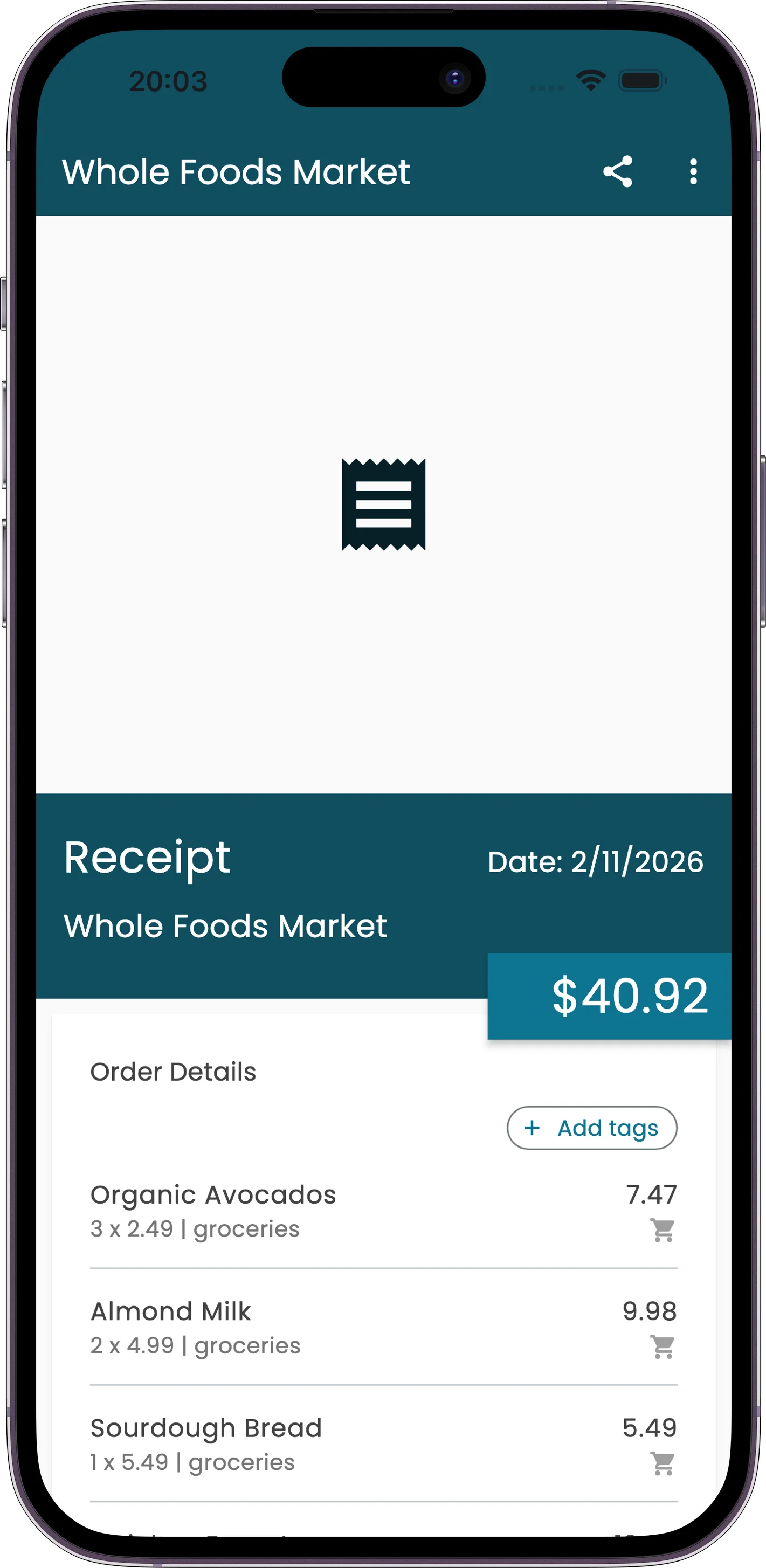
Receiptix is a grocery expense tracker built around the receipt rather than the bank feed. Photograph the receipt on the way out of the shop and the AI pulls out every line — the yogurt, the coffee, the washing-up liquid — with its own price and category. What you get back isn't one number for the trip. It's the breakdown the trip was made of.
Free to start on iOS and Android. Receipt scanning is part of the premium plan; logging by hand is not.
Is This You?
- • You budget $500 a month for food and have no idea whether you hit it.
- • Half your "grocery" spending is shampoo, batteries and a birthday card that happened to be in the same trolley.
- • You buy things you already have at home, because nobody checked the cupboard first.
- • You suspect snacks and drinks are a bigger share than you'd like to admit, but you can't prove it.
- • You've compared two shops on price and given up, because the receipts weren't comparable.
Every one of those is a question the receipt already answers. It just needs reading.
How Receiptix Tracks Grocery Spending
Item-Level Scanning
One photo of the receipt gives you every product, quantity and price as a separate entry. The AI receipt scanner handles crumpled thermal print and long supermarket receipts alike.
Food vs. Everything Else
Smart categorization sorts each line on its own, so the cleaning products in your supermarket trip stop inflating your food number.
Trends Across Months
Charts and reports show whether your weekly average is drifting up, and which categories are doing the drifting.
A Shared Household List
Put the household shop in a shared Project so everyone who shops logs into the same place, and the totals stop depending on one person's memory.
Why Totals Aren't Enough
A card transaction records that you spent $142 at a supermarket. That is a fact you already knew standing at the till. It cannot tell you that $38 went on produce, $27 on meat, $18 on snacks and $18 on household items that aren't food at all.
The difference matters because the useful decisions live inside the total. You can't cut a $142 number. You can notice that snacks and drinks are running at a quarter of the shop, or that the "cheaper" supermarket is only cheaper on the items you don't buy much of.
We've written about both sides of this: how to track grocery spending covers the methods and what each one costs you in effort, and what grocery receipts reveal works through the numbers a full year of them produces.
Common Questions
Does it separate food from household items on the same receipt?
Yes. Each line is categorized on its own, so a single supermarket trip splits across food and non-food categories instead of landing in one bucket. This is the main reason most people's grocery figure looks inflated.
Do I have to scan every receipt?
No. You can add a shop by hand or by voice in a few seconds and skip the detail when you don't need it. Scanning is what buys you the line items — it's worth it for the weekly big shop and rarely worth it for a bottle of milk.
Can it compare prices between shops?
Not automatically, but the data supports it. Because individual products and prices are stored, you can look back at what the same item cost at two different shops rather than comparing two trip totals that contained different things.
Does it connect to my bank?
No. Receiptix reads receipts rather than bank feeds. That's the trade: you capture the shop yourself, and in exchange you get detail a card transaction never carries.
Is it free?
Free to start. Adding expenses by hand, categories and basic charts are included. Receipt scanning, shared projects and export are part of the premium plan.
Read One Month of Receipts
You don't need a year of data to learn something. Scan every food shop for four weeks and the pattern shows up on its own — usually in a category you'd have sworn was small.